
Two founders start similar businesses in the same city in the same month. The first spends three weeks on a business plan. He buys a template, fills in forty pages, agonizes over the executive summary, and prints a clean copy for his binder. The second answers a focused set of questions in under an hour, then spends the rest of that week talking to potential customers. A year later, only one of them is still in business. She is not the one with the beautiful binder.
That story plays out constantly, and it exposes the most expensive myth in business: that a business plan is a long, formal document written to impress. It is not. A business plan is a set of questions, answered honestly. The document is just what those answers look like on paper. Get the questions right and the plan nearly writes itself. Answer them with fog, and no amount of formatting will save the business underneath.
And about that hour: it is a measure of focus, not a stopwatch. The point is not to race a clock, it is that a real plan takes clear thinking, not three weeks of formatting. The moment you can answer the questions below honestly and specifically, your working plan is done, whether that took you forty minutes or ninety.
This article walks through the questions that actually matter, in order, and why each one earns its place. They are the same questions the PushStartGo venture wizard asks, so by the end you will be ready to sit down, answer, and let the platform turn those answers into a finished plan.
What a business plan is actually for
A business plan has two audiences, and they want different things. The first is you: the plan you use to decide what to build, who to sell to, what to charge, and what to ignore. Its job is to force an honest conversation with yourself before real money is on the line. The second is money: a bank, an investor, a grant committee, a serious partner, who want something cleaner, more formal, and backed by numbers they can check.
Nearly every first-time founder writes the money version first, polishing a document to impress strangers before convincing themselves the business makes sense. Reverse it. Answer the real questions honestly, and the persuasive version becomes easy later, because it is just those same answers dressed for company.
A plan is a set of questions, not a document
Here is the reframe that saves weeks. Stop picturing a blank forty-page template and start picturing a short list of questions. Nine of them apply to every business, and they fall into three steps: get the idea clear, know your ground, and name your edge and your obstacle. Answer those nine well and you have a working plan. Everything else is detail.
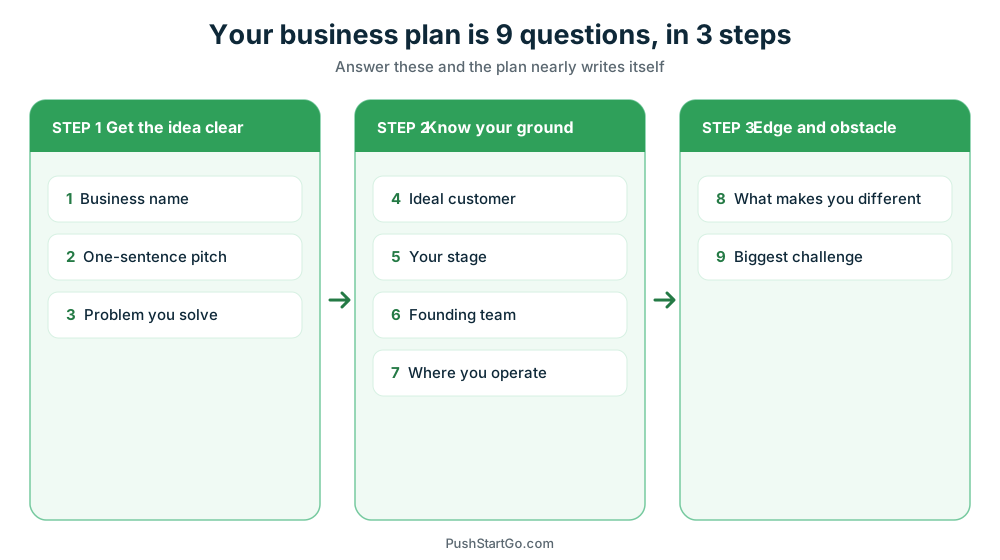
What follows is each question and, more importantly, why it matters. The why is what most guides skip, and it is the difference between an answer written to fill a box and one that actually steers the business.
Step one: get the idea clear
What is your business called?
Start with a name, because a name makes the idea real. It turns "something I have been thinking about" into a thing with edges. Do not agonize, and do not let a missing perfect name stall everything behind it. A working name is enough, and names can change. What matters is that the business becomes something you can point at.
What is your one-sentence pitch?
In a single sentence: what do you do, for whom, and why does it matter?
"I help busy parents get healthy dinners on the table in 15 minutes with pre-portioned meal kits" is a pitch. "I am building a platform to revolutionize the way people think about food" is a fog. This is the hardest line in the plan, and here is the secret that takes the pressure off: even though it sits near the top, it is usually the last thing you nail. A sharp pitch is distilled from the answers that come after it, the problem you solve, the customer you serve, the edge that sets you apart. So take a rough swing now and expect to circle back once those later answers sharpen your thinking. Founders get stuck demanding a perfect sentence before doing the work that produces one. Write the rough version, keep moving, and let the finished pitch reveal itself. When it lands, everything downstream gets easier, because a clear sentence is proof you understand your own business.
What problem are you solving?
Every business solves a problem for someone. State it in the words your customer would use, not the language of your solution.
Think about Henry Ford. He is remembered for the moving assembly line, but that was never the problem he was solving. The problem was that cars were a luxury only the wealthy could afford, and he wanted to build one an ordinary family could buy. The assembly line was just his answer. His customers never asked to tour the factory; they cared that the Model T was affordable, not how it got that way. The buyer looks at the outcome, not the machinery behind it.
That is the trap: founders fall in love with their product, while customers only care about their problem. What you want to deliver and the outcome the customer wants are two sides of the same coin, and they can be wildly different. Ford's coin had a brilliant assembly line on one side and a family finally able to own a car on the other, and the customer only ever saw one side. Describe the problem clearly, in the customer's terms, and the solution has something solid to stand on. Leave it vague, and the business is just a product searching for a reason to exist. This is one of the seven questions every founder must answer before spending a dollar.
Step two: know your ground
Who is your ideal customer?
Describe the one person most likely to buy, as narrowly as you can. "Small business owners" is too broad to act on. "Solo consultants who bill 80 to 150 thousand dollars a year, hate spreadsheets, and do their books at 11pm the night before taxes are due" is someone you can find, reach, and speak to directly.
Founders resist narrowing, afraid it shrinks the market. The opposite is true: a narrow customer tells you exactly where to advertise, what to say, and what to build first. Precision is a map, not a limit. You can widen later, but you cannot sell to everyone at once on one person's budget.
Where are you right now?
Be honest about your stage: an idea, validating demand, building, soft-launched, or already earning revenue. It changes what you should do next. A founder at the idea stage should be talking to customers, not building features; one with early revenue should double down on what works, not rewrite the plan. Naming your stage stops you borrowing a later-stage founder's to-do list and wondering why nothing fits.
Who is on your founding team?
List who is building this and what each person brings. Solo is fine, and plenty of great companies start with one person. This question earns its place because businesses are built by people, and honest founders name their gaps. If nobody has ever sold anything, that is not a reason to quit, it is a reason to learn or hire for selling first. Investors bet on people as much as ideas, and so should you.
And if the missing piece is a person rather than a skill you can pick up, say so out loud. One of the reasons PushStartGo exists is to bring founders and builders together, so the right people can find each other, team up, and build something none of them could alone.
Where will you operate?
Local, regional, national, or global. This shapes almost everything practical: which rules apply, how big the opportunity is, how you reach customers, and what it costs to grow. A neighborhood bakery and a software company selling worldwide can share the same passion and still need completely different plans. Decide your reach early, so you are not planning for a market you are not built to serve yet.
Step three: your edge and your obstacle
What makes you different?
Name why a customer would choose you over what they do today, and know that "nothing" and "better quality" are both wrong answers. Everyone claims better quality. A real edge is specific and defensible: cheaper, faster, easier, more trusted, or built for a niche nobody else serves. "The only meal kit designed specifically for diabetic households" is an edge. Your competition is always something, even if it is only the customer choosing to live with the problem. If you cannot say why you win, neither can the customer.
What is your biggest challenge right now?
Name the thing most likely to stop you: finding customers, raising money, a missing skill, a crowded market. Anxious founders most want to skip this one, and it pays off the most, because you cannot solve a problem you refuse to name. Writing the real obstacle down turns vague dread into a concrete task you can work on, and tells you where to spend your energy first, which is worth more than another polished paragraph anywhere in the plan.
Then it gets specific to your business
The nine questions apply to everyone. From there a good plan gets specific to what you sell, and this is where the PushStartGo wizard adapts: a software business is asked about core features, pricing model, price point, competitors, how it will be built, and how it will find customers, while a product or service business gets the questions that fit its world.
Whatever the type, one question always shows up: how do you make money? Slow down, because this is where dreams meet arithmetic. Write down your price, how you charge (one-time, subscription, commission), and the piece founders skip, the unit economics: when you sell one unit, what does it cost to deliver, and what is left over? Sell a 50 dollar product that costs 35 dollars to make, ship, and support, and 15 dollars is left to cover rent, time, marketing, and mistakes. Businesses rarely fail for lack of customers; they fail because each customer costs more than they bring in, and nobody notices until the account hits zero. Pricing that works is a real skill, and getting it wrong kills more businesses than bad products do, so read how to set a price for your product or service before you commit.
One more thing trips up new founders. The headlines are full of venture rounds, private equity buyouts, eye-watering raises, and glamorous exits, and it all sounds like the real game. Chasing that glamour is one of the fastest ways to lose the plot. Every one of those raises and exits sits on the same unglamorous foundation you are building now: a business that works, solving a real problem for a customer willing to pay. Investors do not fund excitement, they fund traction, and traction is just proof the fundamentals are sound. Money follows a working business, not the other way around. Get the customer, the problem, and the unit economics right, and funding becomes a tool you might reach for later. Skip them, and no amount of investor interest saves you, because there is nothing underneath to invest in. The raise is never the achievement. The business is. The rest is noise.
The mistakes that quietly kill good businesses
A few traps cost founders months, and sometimes whole companies. None are about the idea being bad. They are about how a founder relates to the plan.
The deadliest is planning forever and never building. Planning feels productive: it is safe, quiet, and never risks rejection. Talking to a real customer, charging a real price, and shipping a real product can all fail in public, so an anxious mind keeps finding one more thing to research and one more section to polish. Months pass, the plan gets thicker, and the business stays imaginary. The hard truth experienced founders learn: a plan has never earned a dollar. Only action does. A plan is a map, and a map is worthless until someone starts walking.
This is the gap PushStartGo was built to close. A document in a folder cannot tell you what to do on Tuesday morning; a project can. So instead of letting the plan go stale, the platform turns your answers into a project you can actually build, breaking each goal into concrete tasks with owners and dates. The daily question stops being "is my plan good enough" and becomes "what do I ship today." That shift, from planning to doing, is the most important move a new founder makes, and the one the beautiful-binder founder never made.
The other traps are quieter but just as costly. Perfecting the document instead of testing the idea wastes hours that belong to customers, because the market does not grade formatting, it grades whether anyone will pay. Confusing a big market with an easy one puts you against a thousand better-funded competitors, when a niche you can own beats an ocean you drown in. And waiting for certainty is just fear in a costume, because no founder has all the answers before starting; the plan is there to help you make good bets under uncertainty, not to erase risk you cannot erase.
The last trap is the mirror image of the first: treating the plan as finished the moment it is written. Early on especially, the plan is a living document, not a monument, meant to change as the market shifts and new information arrives. Your first version is a best guess the market is about to grade. If real customers tell you the problem you picked is not the one that keeps them up at night, or that they value something else you bring, believe them and adjust. The founders who last hold their plans loosely, revisiting them and reshaping what they bring to market around what real customers need, which is rarely what you first wished they wanted. Holding too tightly to your plan is just another way of loving your product more than your customer, and the market has a way of ending that romance for you.
When you need the longer, formal version
Everything above is the working plan, the one you answer for yourself. The formal, investor-ready version earns its keep the moment you ask someone else for money or a serious commitment: a bank loan, an investor, a major supplier, a co-founder giving up a salary. Those audiences need detail, evidence, and polish. The good news is that the formal plan is just your nine answers, expanded and supported with real numbers, which is exactly what the platform helps you produce once the thinking is done.
Before that, put the practical foundations in place. If you are unsure whether to be an LLC, an S-Corp, or a C-Corp, start with the plain-English breakdown of the three structures. Once that is settled, opening a business bank account and getting an EIN are quick, mostly free steps, and the full idea-to-incorporated launch checklist walks the whole sequence in order.
Do it right now
A business plan was never meant to take three weeks. It takes as long as answering nine honest questions, closer to an hour than a month. The founders who win answer the hard questions clearly, then go do something about it. A thick binder never impressed a customer.
When you are ready, PushStartGo's venture wizard asks these exact questions, uses AI to turn your answers into a real, fundable plan, then breaks that plan into a project you can start building the same day. Answer the questions. Let the platform handle the document. Then go find your first customer.
A business does not need a perfect plan. It needs a founder who has answered the hard questions honestly, and then started to build. That is what the hour is for.