
If you think a business plan is something you write once, to get started, and then file away, you are wrong in ways that will quietly cost you. That belief is why so many plans end up in a drawer, and why so many businesses drift. The plan was never meant to just be a starting ritual. Its most valuable years come after you launch, not before.
Two founders launch strong businesses in the same year. The first treats the plan as a finished thing, files it away, and spends the next twelve months reacting to whatever lands in the inbox that day. The second, a founder named Dan, keeps his plan open on his desk, revisits it at the end of every month, and adjusts it as the market talks back. A year later, one of them can tell you exactly why the business is winning and what to do next, and the other is busy but lost. The plan did not make the difference by existing. It made the difference by staying alive.
A plan is a starting line, not a finish line
The myth is that the plan's job ends the moment you open your doors. In truth, that is when its real job begins.
The boxer Mike Tyson said it best: "Everybody has a plan until they get punched in the mouth." For a founder, opening the doors is the punch. The market you imagined on paper collides with the market that actually exists, and the gap between the two arrives as real customers, real objections, and real dollars. That first blow is not proof your plan was wrong. It is the exact moment the plan was built to prepare you for, and the moment it has to start changing.
Before launch, a plan is your best guess about a market you have not met yet. After launch, the market starts voting with its wallet, and every sale, every no, and every surprising request is new information the plan should absorb. A plan you never revisit is frozen at your moment of maximum ignorance, the day you knew the least you would ever know about your own business. Think of it as a steering wheel, not a birth certificate. A birth certificate records one moment and never changes. A steering wheel is only useful because you keep turning it.
Plans are worthless until they drive action
Here is the idea that ties this whole thing together, and it is worth slowing down on. A plan, by itself, has never done anything. It is belief on paper. It only becomes valuable when it drives what you actually do, this week, on Tuesday morning. The point of a business plan is not to be read. It is to decide your actions.
That means the real shape of running a business is a loop: your plan sets the strategy, the strategy becomes a project, the project becomes the tasks you work through, the work produces results, the market reacts, and that reaction sends you back to update the plan. Around and around. When the loop is healthy, your daily work always reflects your latest, smartest thinking. When the plan freezes, the loop breaks, and here is the quiet danger: your project keeps running on last year's strategy. You stay busy, you check things off, and none of it points at the target you would choose today if you were paying attention. A stale plan does not just sit there harmlessly. It steers you, in the wrong direction, with confidence.
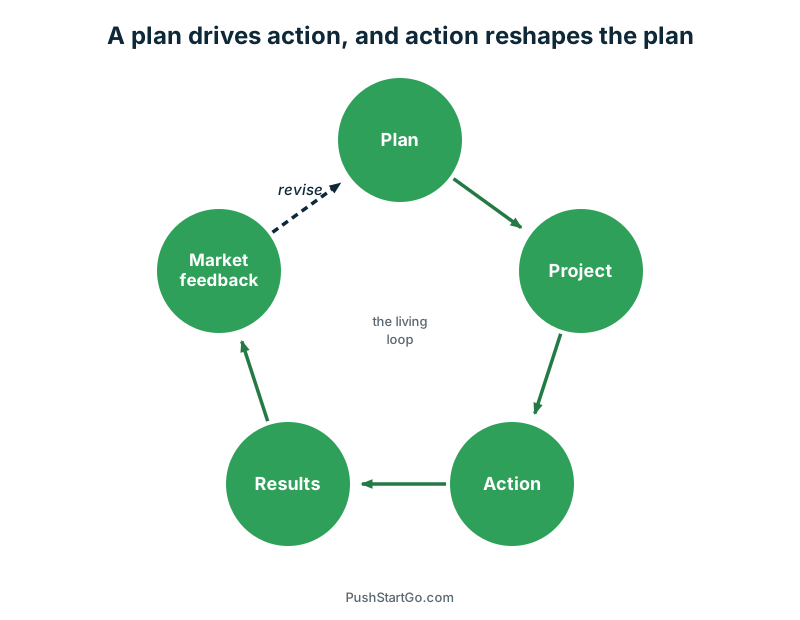
This is the whole reason PushStartGo exists. A plan is only as good as the actions it sets in motion, so PushStartGo treats your business plan as the template for what you actually do, translating your strategy into the concrete steps you work through. And because the plan is meant to change, revisiting is built into the rhythm: when the plan changes, the actions that follow change with it, so your day-to-day work always traces back to your latest thinking instead of a strategy you have quietly outgrown. Your plan sets the actions, the market teaches you something, you revise the plan, and the actions update in turn.
So revisiting the plan is not homework. It is how you make sure the work filling your week is still the right work.
Three reasons to reopen the plan
Once the business is live, three forces should pull you back to the plan on a regular basis.
To focus on what is working
The first is the happiest one. Somewhere in your first year, the market will show you that it loves one particular slice of what you do, one customer type, one product, one use case that keeps coming back. That signal, that a specific offer clicks with a specific customer, is what people mean by product-market fit, and it is the most valuable thing a young business can find. When you see it, the right move is usually to narrow, not to spread. Revisit the plan and rewrite it around that slice: pour your attention, your money, and your marketing into the thing that is already working, and quietly set aside the parts that are not. Founders who never revisit miss this entirely, spreading themselves thin across everything they planned to do instead of doubling down on the thing customers are actually buying.
To pivot on real evidence
The second reason is harder and just as important. Sometimes the market tells you that the problem you picked is not the one people will pay to solve, or that they want something next to what you built rather than the thing itself. That is not failure. It is information, and it is exactly what an early plan is supposed to surface. The founders who last hold their original idea loosely. They reshape what they bring to market around what real customers actually need, which is rarely the same as what the founder first wished they wanted. Reopening the plan is how a pivot becomes a deliberate, evidence-based decision instead of a panicked lurch. You change the plan because the market gave you a reason, and then you change what you build to match.
To update the money
The third reason is the one founders most often forget: the finances. When you first wrote the plan, your numbers were educated guesses. What does it really cost to serve a customer? What price does the market actually accept? How much does it cost to win one? A few months of real operating data answers these far better than any forecast, and the answers should flow straight back into the plan. Maybe your true costs are higher than you hoped and the price needs to move. Maybe a product line looks busy but loses money on every sale. Maybe the margins are strong enough that it is finally time to think about funding growth. This is where the plan meets arithmetic all over again, and if pricing is the piece that has drifted, it is worth revisiting how you set a price for your product or service before you lock in new numbers.
The numbers also do not sit in isolation, so feed the real figures back into your financial model and watch the ripples. A higher true cost to serve changes how much cash you need on hand and how long your runway lasts, which can turn a comfortable position into an urgent one, or the reverse. A clearer read on what it actually costs to acquire a customer tells you whether your marketing spend is buying growth or quietly burning money, and often reveals that the channel that felt cheap is the expensive one once you count every dollar. Updating the money is not just fixing a price. It is refreshing the whole model, so your decisions about spending, hiring, and whether to raise are based on what is true now rather than what you guessed a year ago.
When to revisit, and what should trigger it
Two rhythms keep a plan alive. The first is a steady cadence: pair a look at the plan with a regular financial check-in, so that once a month you sit down, look at what the numbers are telling you, and ask whether the strategy still fits. It takes an hour and it prevents a year of drift.
The second rhythm is event-driven. Certain things should send you back to the plan the moment they happen, no matter the calendar: a marketing channel that was working suddenly stops, a customer segment you barely noticed starts growing fast, your costs jump, a big competitor appears, or a funding conversation gets real. Each of these is the market handing you new information, and new information is exactly what the plan exists to absorb.
Zoom out: quarterly and yearly strategy
Not every revisit is a reaction to something going wrong. The most valuable ones are deliberate and forward-looking: a scheduled hour or afternoon each quarter, and a longer session each year, where you step back from the daily work and ask the bigger questions. Where is the business actually heading? What is working well enough to build the next year around? What did we assume twelve months ago that is no longer true? These strategy sessions are where a plan stops being a record of the past and becomes a rudder for the future.
Plenty of founders still keep a five-year plan, and there is nothing wrong with a long horizon. But the cycles that shape a business move faster than they used to. Markets shift, tools change, and competitors appear in months rather than years, so a strategy you set once and never touch is out of date before the ink dries. A five-year plan is a direction, not a schedule, and it only stays useful if you hold it up against reality on a regular beat.
Think of the plan as a map and the market as the terrain. A map is invaluable, but only if you keep looking at it while you walk, checking what it promised against the ground actually in front of you and redrawing the parts that do not match. The founder who folds the map away and marches on from memory gets lost. The one who keeps glancing between the map and the terrain, updating the map as the land reveals itself, is the one who arrives.
Re-ask the questions you started with
A good way to revisit is to return to the same questions that built the plan in the first place. When you wrote your original plan, you answered nine of them, and every one has a different, sharper answer once you have real customers.
Your ideal customer, once a guess, is now a real pattern you can see in your sales. Your stage has moved from idea to revenue, which changes what you should focus on next. Your edge, the thing that makes you different, is now something customers can confirm or deny rather than something you hoped was true. And your biggest challenge has almost certainly changed, from "will anyone buy this" to something more specific about growth, hiring, or margins. Re-answering the same nine questions with real data, instead of hope, is one of the fastest ways to see how far the business has actually moved and where it needs to go.
From plan to project: why any of this matters day to day
Here is where the whole idea becomes practical, and it is the reason PushStartGo exists. A plan changes nothing until it becomes the work you do. So PushStartGo is built to distill your business plan into a project and an actionable list, turning your strategy directly into the tasks that fill your week. Your plan stops being a document you admire and becomes the thing that decides what you build next.
That is also why keeping the plan alive matters so much here. When you revisit the plan, to focus on the slice that is working, to pivot on what customers told you, or to fix the numbers, you are not just editing a paragraph. You are regenerating the project. The plan re-drives the tasks, and the tasks re-drive your week, so the work in front of you always points at your latest, best thinking instead of a strategy you quietly outgrew months ago. A living plan, in practice, is a living project. That loop, from plan to project to action and back again, is the engine the whole platform was designed around.
The mistakes that keep a plan from earning its keep
The first mistake is treating the plan as a monument. It gets written once, admired, and never touched, so the business runs on assumptions that expired long ago. The cost is not obvious, because everything looks fine on the surface, right up until you realize you have spent a year executing a strategy you no longer believe in.
The second mistake is the opposite, thrashing. Some founders, having heard that pivoting is good, change direction on every stray comment and gut feeling, rewriting the plan so often that the business never builds momentum in any one direction. There is an old saying that lack of focus kills as many companies as lack of capital, and the research gives it teeth. In analyses of startup post-mortems, most famously the ongoing one by CB Insights, running out of cash is one of the leading causes of death, named in roughly a third of failures. But focus-related problems crowd in right beside it: losing focus, trying to do too much, and pivots gone wrong turn up again and again, and one of the most common killers of all, building something the market did not truly need, is itself a failure of focus. Constant course-correction can feel like progress while quietly producing none.
Seth Godin gave this trap a name in his book The Dip: the stretch where things get hard before they get good, the long slog between the thrill of starting and the reward of breaking through. Almost every strategy worth pursuing has one. The founder who thrashes tends to quit right there, mistaking the dip for a dead end and leaping to something new that has its own dip waiting. Learning to tell the difference, between a strategy that is genuinely wrong and one that is merely in the hard middle, is most of the skill.
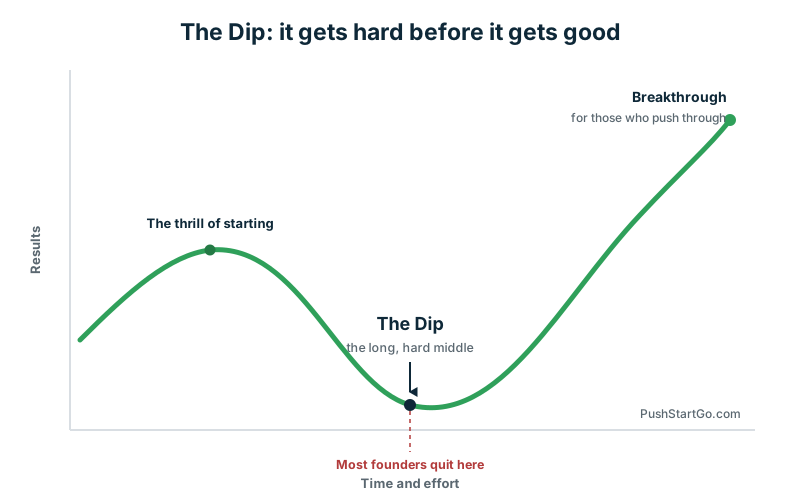
The fix is the word evidence. Revisit on a rhythm and on real signals, not on moods. A plan should change because the market gave you a reason, not because you got nervous on a Sunday night.
The third mistake is revisiting everything except the money. It is tempting to update the exciting parts, the vision and the marketing, while avoiding the spreadsheet. But the numbers are where the truth lives, and a plan that never revisits its unit economics can look healthy while quietly losing money on every sale.
The fourth is the quietest: clinging to the original vision out of ego. Admitting the plan needs to change can feel like admitting you were wrong. You were not wrong. You were early, and being willing to update is not weakness, it is the entire skill. The market does not reward founders for consistency. It rewards them for being right, eventually.
Your plan is never finished
The most useful mental shift you can make is to stop seeing the business plan as a document you complete and start seeing it as a conversation you keep having with the market. You write your best guess, you act on it, the market answers, and you update. That loop, run over and over, is what actually builds a company, and it is why the founders who keep their plans alive tend to be the ones still standing years later.
So do not file it away. When your plan changes, and it will, let it regenerate the work. Turn your business plan into a living project with PushStartGo, and every time you sharpen the plan, sharpen the very next thing you build. A plan that drives your actions is the only kind worth keeping.