
A founder gets a piece of advice that is exactly right. Someone they trust tells them the thing they needed to hear: fix the pricing, call the ten quiet customers, stop building features and go sell. They nod, they mean it, they write it down. And then, three months later, the pricing is unchanged, the customers were never called, and the feature list grew. The advice was not wrong. It was not even forgotten, not really. It simply never crossed the distance between being understood and being done.
This is the most common way advice fails, and it is worth sitting with how strange it is. The hard part is supposed to be getting good advice. You would think that once a founder knows the right thing to do, the doing would follow. It does not, reliably, and the gap between knowing and doing swallows more good advice than bad advice ever could. Understanding why that gap opens, and what actually closes it, is the difference between advice that changes a business and advice that just makes for a good conversation.
Knowing is not the hard part
There is a name for this, the knowing-doing gap, and it describes a problem almost every founder has lived. The knowledge is not missing. The founder could tell you exactly what they should do; they have read it, heard it, maybe paid for it. What is missing is the bridge from that knowledge to a changed action on a Tuesday afternoon when the knowledge is competing with a hundred urgent things that are easier and louder.
Advice arrives as an insight, and an insight is a fragile, abstract thing. "Raise your prices" is clear in the moment and vague by Thursday: raise them to what, for whom, starting when, and what do you say to the customers. The gap between the clean idea and the messy specifics is where good intentions go to die, because the idea never got broken down into a concrete next action small enough to actually do. A founder does not fail to raise prices because they disagree. They fail because "raise your prices" was never turned into "draft the new pricing on Monday, email these five customers on Wednesday," and the unconverted version loses every time to whatever is already on the calendar.
Why the gap is structural, not a willpower problem
It is easy to read all this as a discipline failure, to assume the founders who do not execute are simply less committed. Some advice does die of genuine disagreement or bad timing. But most of it dies for structural reasons that have nothing to do with how much the founder cares.
An insight with no structure behind it has to be re-remembered and re-decided every single day, and it competes, every day, with work that is already scheduled and already screaming. Strategic advice is almost never urgent; it is important, which is exactly the category that quietly loses to the urgent when nothing protects it. The founder is also, usually, carrying the whole business in their head, so a new intention is one more thing to hold alongside everything else, and the things being held by memory alone are the first to slip under load. None of that is a character flaw. It is what happens to any good idea that is not converted into a protected, concrete, visible piece of work. The plan stays a plan, and a plan you cannot act on is just a wish.
The Eisenhower Matrix, and why advice lands in the quadrant that gets ignored
There is a simple framework that makes this concrete, often called the Eisenhower Matrix after the president who described the idea. It sorts everything on your plate along two lines: how urgent it is, and how important it is. That gives four quadrants. Urgent and important is the fire you fight right now, the angry customer, the payroll that is due. Urgent but not important is the noise that feels pressing but barely matters, most notifications and many emails. Not urgent and not important is the busywork and the distraction. And then there is the fourth quadrant, important but not urgent, which is where nearly all real strategic advice lives: fix your pricing, build a referral engine, call the quiet customers. It matters enormously, and nothing about it is on fire today.
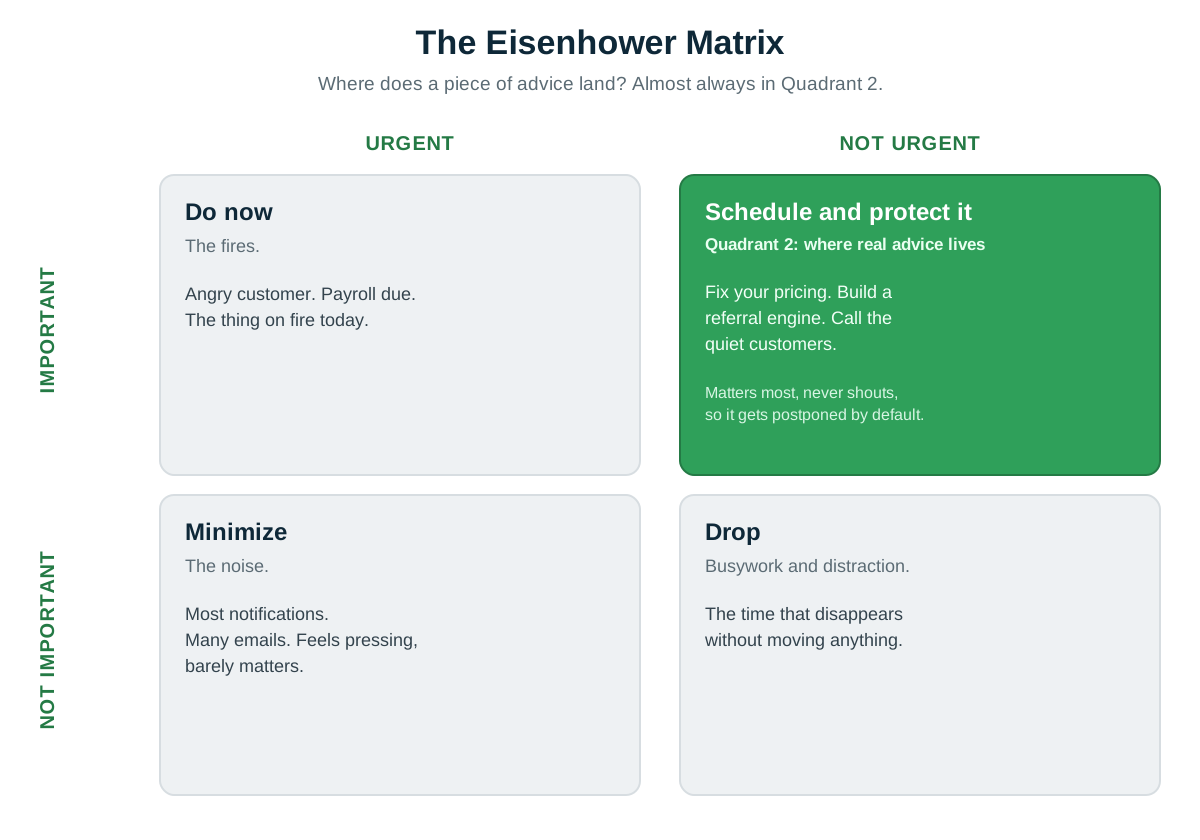
The whole lesson of the matrix is that the important-but-not-urgent quadrant is the one that decides your future and the one you will neglect by default, because it never shouts. Urgent work announces itself; important work waits politely and loses. So when an advisor hands you a genuinely valuable insight, they are handing you a Quadrant 2 task, and Quadrant 2 is precisely the pile that gets perpetually postponed to a tomorrow that never comes. This is not a mystery of motivation. It is the predictable physics of a founder's day, where the loud beats the important unless something deliberately protects the important. The only way Quadrant 2 work gets done is by scheduling it and making it visible, so it stops having to win an unfair fight against whatever is currently on fire.
What actually closes the gap
Advice gets done when it stops being an insight and becomes a task. That is the whole move, and it is less glamorous than the advice itself, which is why it gets skipped. The bridge across the knowing-doing gap is built out of unremarkable things: breaking the insight into concrete steps, attaching those steps to specific moments, keeping them visible so they do not have to be re-remembered, and checking back so the thread does not drop.
"Improve your customer retention" does not get done. "Email the three customers who have not ordered in sixty days, this week, with this offer" gets done, because it is small, specific, scheduled, and in front of you. The translation from the first form to the second is the real work of execution, and it is work most advice never includes, because the person giving the advice stops at the insight and the person receiving it does not know how to convert it, or has no system that does. Close that gap and the same advice that used to evaporate starts to actually change the business. Nothing about the advice got better. It just got turned into something a busy person could do.
Consider a founder named Marcus who had been told for a year to focus, to stop chasing every new idea and finish one thing. He agreed every time and changed nothing, because "focus" is an insight, not an action. The thing that finally moved him was not better advice; it was the same advice broken into a short, visible list of concrete steps tied to his actual week, so "focus" became three specific tasks he could see and do. The abstraction had never been actionable. The list was.
The three things that have to be true
If you want to know whether a piece of advice will actually get done, do not ask whether it was good. Ask whether it has been turned into something with three properties, because advice that lacks any one of them tends to stall no matter how right it is.
It has to be specific. "Improve your margins" is a direction, not an action; "renegotiate the two supplier contracts over five thousand dollars this quarter" is something a person can start. The more the advice still needs to be interpreted before anyone can act, the less likely it is to survive, because interpretation is friction and friction is where good intentions stop. It has to be scheduled, attached to an actual when, because strategic work is never urgent and anything without a time attached loses, every day, to the things that do have a time attached. And it has to be visible, kept somewhere the person will see it without having to remember it exists, because a plan you have to re-remember is a plan you will eventually forget on the one busy week that matters.
Specific, scheduled, visible. Most advice is none of the three. It arrives as a smart, true, abstract statement, with no when and no home, and then everyone is surprised when it does not happen. The work of execution is almost entirely the work of giving advice those three properties, and it is unglamorous enough that both the person giving it and the person getting it tend to skip it, which is precisely why so much good advice dies with none of them in place.
Where a shared system comes in
This is the gap PushStartGo was built to close, and it is why the platform does not stop at giving you a plan. It turns the plan into a project, breaking the strategy into concrete tasks tied to your real work, so the insight does not stay an abstraction you have to reconvert every morning. The knowing becomes a doing you can see.
The part that matters most is that this is not one more thing to use on top of running your business. It is where you run your business. The advice that became a task sits in the same daily list as everything else you do, so the important-but-not-urgent work the Eisenhower Matrix warns about is finally competing on even ground with the day's fires instead of hiding in a notebook. In practice that looks ordinary, which is the point: you open it in the morning and the few things that actually move the business are right there next to the operating work; you check off the pricing email you sent and watch the strategic task shrink like any other; the weekly review shows you what progressed and what stalled, so a postponed Quadrant 2 item surfaces instead of quietly disappearing. Because it goes along with the work you already do rather than adding a separate place to maintain, the advice keeps showing up where you will actually act on it, day after day, which is the only place advice ever gets done.
It matters even more when there is an advisor involved. When a founder is working with a consultant, a mentor, or a coach, the handoff from the advisor's insight to the founder's action is exactly where things usually break. On a shared layer, that handoff has somewhere to land: the advisor and the founder can turn the conversation into assigned tasks together, the founder works against those tasks between sessions, and both can see what actually moved. The advice does not evaporate in the gap between meetings, because the gap now has a structure running through it. An advisor who closes the knowing-doing gap for their clients, rather than leaving them to cross it alone, is one whose advice keeps working between the meetings, and whose clients therefore actually get where they were trying to go.
The mistakes that leave advice undone
The biggest mistake is treating the insight as the finish line, on either side of the table. The advisor delivers the clever diagnosis and considers the job done; the founder collects the clever diagnosis and feels, for a moment, like progress has been made. But understanding what to do is not doing it, and the warm glow of a good insight is easy to mistake for the change it has not yet produced.
Another is leaving advice in its abstract form, nodding at "improve retention" or "get focused" without ever forcing it down into a specific, scheduled, small enough action. Abstractions cannot be executed. They have to be translated, and the translation is the step most often skipped.
There is also the mistake of relying on memory and motivation to carry a plan, trusting that caring enough will be enough. Caring is real and it is not a system; the most committed founder in the world still loses important-but-not-urgent work to the urgent when nothing holds it in place. And there is the quieter mistake of collecting advice as a substitute for acting on it, moving from one source of insight to the next, feeling productive, while the previous advice sits unconverted. More knowing does not close the gap. Only doing does.
From knowing to done
Go back to that founder with the advice that was exactly right and still never happened. They did not fail because the advice was wrong or because they did not care. They failed because the advice stayed an insight and never became a task small enough to do on a Tuesday. The gap between knowing and doing is where most good advice dies, and it closes only when the insight is turned into concrete, visible, scheduled work.
That translation is the real work, and it is the work most advice leaves out. When you want the good advice you have already heard to actually get done, PushStartGo turns the plan into a project you can act on, so knowing finally becomes doing.